This Gardening Life

Tuesday, November 08, 2011

Inspiring trip to Rancho Reubidoux

It's autumn, which means time for major clean up at Casa Grande. The recent wind and rain has left the place pretty ragged. But the big Chinese elm in the backyard is going to be trimmed next week, so no point in doing any vacuuming of the pea stone yet.

In the meantime, EZ Go Marge, Bug Blog sister and I trekked to Rancho Reubidoux for their Garden Bazaar on Saturday. FUN! I loved the way the garden is laid out with a nice seating area defined by wooden decking level with the pea gravel. (I love pea gravel!)

This pitchfork was turned into a planter.

I purchased an old colander ($10!) with a nice grey/green patina and used the pitchfork idea to make a planter.

Thanks to the friendly owners of Ranch Reubidoux for an inspiring day. Can't wait for their next sale.

Labels: , ,

Monday, May 18, 2009

It's Only Fair


As you can see by the dates on this blog, I've been out of touch for a few weeks. It's Fair Time! Or at least Pre-Fair Time, which is really busy for me.

This year with the new Administration Building not yet complete, the exhibits department has relocated to the Centennial Farm. Other departments are scattered around the farm area in trailers. One of the really pleasant things about this is that there are always school children and their teachers running around, the oxen team is out of their stall and demonstrating their talent, and when picking up the mail or delivering something to one of the trailers, I have to pass by the herb garden, or give the lamb named Obama a little chuck under the chin, or say hello to the pigs who have been safely sequestered from humans who might give them the flu.


Passing the herb garden, I like to tug on the rosemary, fennel or dill and take the lovely earthy scent with me back to my desk.

Wednesday is entry deadline for this year's OC Fair. If you grow the prettiest flowers, the biggest pumpkins, paint the best pictures or take gorgeous photos, you will want to get those entries in. I'll be in the Silo building helping folks who don't use a computer enter their handiwork today and tomorrow.


Meanwhile, back at Casa Grande, with Biker Boy riding cross country in the Mojave desert for the weekend, and Saturday's successful de-accessioning of some of my no longer needed earthly goods, Sunday was spent cleaning up (nyjer seed! ARGH.) and rearranging plants. Some that are a little sun sensitive, like the potted Gruss an Achen roses and Brunfelsia latifolia, were pushed into a part of the garden that gets filtered afternoon shade.

The Katz Brothers were also happy I was home.


Labels: ,

Monday, April 27, 2009

Hope Springs Eternal...

..in the human breast, said Alexander Pope.

He must have been a gardener.

This scrawny excuse for a lilac bush was planted in the front of Casa Grande more than 5 years ago. I've lost count of the springs I have waited patiently for a bloom or two, hoping for a whiff of that lovely and nostalgic scent known to all who have lived in a climate with a winter freeze. April is the cruelest month.

Alas! Alack!
And Eureka! My sorely tried patience has been richly rewarded. Meager though these blooms may be, the smell is one and the same of my childhood spent in a colder climate....not that I want to go back there, no, no. The scent of these few blooms will suffice.

Next year....

Hope springs eternal in the human breast.

Labels: , ,

Tuesday, April 21, 2009

Suck it up

Did I mention my love affair with pea stone? Yes? The easy care, low cost landscaping material has many benefits. There are but two maintenance jobs, weeding and vacuuming. Weeding is done by hand unless it gets out of hand, then out comes the Round Up. The vacuuming is more of a pain in the neck, literally.

After raking up the fallen leaves, the shedding bark from the Chinese elm, and other debris into piles (did I mention raking? and untangling the annoying 100 ft. extension cord?) I put on a mask and protective glasses and strap on the Black and Decker. It's back breaking work for a vintage gardener, but the result is so worth it. Also probably qualifies for weight-bearing exercise, important for said gardener. Team that up with some sunshine and you've multi-tasked your way to better bone health. ( Be sure to wear the mask.)

Labels:

Friday, April 17, 2009

99 Cents ONLY!

Biker Boy loves the 99 cent store. On a casual Sunday afternoon last fall he convinced me to take a break from autumn planting season and come along to check out the bargains.

One of my old colleagues and friends from grad school days told me he bought all his cactus and succulents at the 99 cent store. Just repotted them and left them out somewhere in his orange orchard to grow unattended. He had apparently scored hundreds.

When I arrived at the 99 cent store and saw a rack full of said plants, I bought some. Maybe more than some. Very rewarding! Cheap plants and some nice 10 inch clay pots also for 99 cents each. (Not pictured here.) Must return for more. The little guys are growing and flowering. One of my weekly mow and blow crew said he loves to pass by the mini-collection because it reminds him of home. (Arizona) (sigh)

These are but a few... Sadly, they did not come with name tags.

Labels:

Thursday, April 16, 2009

A Breakthrough with Wisteria

I've been dreaming of growing a wisteria arbor since I visited Monet's Garden in Giverny, France many years ago and read Wallace Stegner's book Angle of Repose. Stegner made his "wistaria" arbor sound so romantically early California, I thought for sure Casa Grande needed one. But for some crazy reason I have not been able to get one to take hold and flower. For most, the twining vine with the gorgeous purple pendulous blossoms are like Kudzu needing constant vigilance lest it take over the house. In Sierra Madre there is an entire house that was eaten by a wisteria vine.

I thought I had finally gotten one to acclimate and flower in 2003. The vine pumped out a few meager blooms, maybe three. But then we had torrential rains in January 2004. 15 inches in like a day and a half. The poor thing drowned. (Or maybe not.) So I planted another in the backyard on a new iron trellis and hoped for the best once again. Last year I got about a dozen blooms. This year, hallelujah!! and thanks to Pat Welsh by way of my sister, I have a vine full.
Constant pruning is apparently essential. Also sun. Also good drainage. And for insurance, in late winter, I dumped a bucket of epsom salt solution at its base. (Thanks Cindy McNatt!)


Here is some good advice from www.plantanswers.com:
Reluctance of wisteria to bloom abundantly is usually due to a lack of one or more of the following cultural requirements: full sun, good drainage, and light fertilization in the fall, not spring. Another essential is annual pruning, which can be done by shortening new shoots to five buds in summer. If a grafted or cutting-grown Chinese wisteria refuses to flower in three or four years after planting, or a Japanese wisteria is barren after about seven years, prune it heavily and fertilize with superphosphate. If this fails to produce blooms root-prune by driving a spade into the soil 24 inches from the trunk around the plant OR beat the devil out of the trunk!!!


So, guess what happened this year? A strong new wisteria vine has popped out of the ground where the poor drowned one had been planted previously. I guess they really are hard to kill.

Labels: , ,

Monday, April 13, 2009

A Kind Word About My Tree

At the far end of town where the grickle grass grows..."

When Jorge was a mere tyke his favorite book was The Lorax by Dr. Seuss. It was read daily for so long we had it memorized.

Eleven years ago during a major downsizing I fell in love with a wreck of a house with an 80 year old Chinese elm in the wreck of a backyard. The tree reminded me of The Lorax. The poor elm had been badly pruned, and then not pruned at all for some time. Though neglected, it exuded a regal air and a sturdy elegance.

Through the years and yearly pruning, the elm has taken on a lovely shape with sinewy long limbs that umbrella the entire backyard of Casa Grande in a cooling shade throughout the summer. It's too big to photograph in one frame due to it's shape and the tightness of the space around it. The trunk at it's base looks like the torso of a woman standing contrapposto. (I read somewhere that trees and humans share 50% of their DNA.)


The elm also provides a fair amount of privacy. With it's arms leafed out from March through November, the yard beneath the tree is not visible on Google Earth.

Labels: ,

Friday, April 03, 2009

Groundlings, or, Standing Room Only


With very little money but an itch to see the newest play by that fellow Shakespeare, you would have purchased a ticket to stand in back with the other "groundlings" hoping to see and hear well enough to enjoy the show. In my garden, in spaces too small or narrow to do anything but stand and look, groundlings hug the dirt, adding color, charm and generally cleaning up the view as I pass from my car to the backyard.


These are not the "steppables" marketed as so by Armstrong Nurseries. They are shade tolerant, creeping and awfully pretty when they flower. Shown here are Lamium, Australian Violets, Nasturtium.

Labels:

Wednesday, April 01, 2009

Stag Party

Many years ago, so many I cannot remember being without them, my mother or someone, maybe my dentist, gave me a staghorn fern...one Platycerium bifurcatum. Through the years, one plant has become many. Some were given away or sold in yard sales. The ones that remain have been either divided and mounted, or were given their very own structures to cling to. Some have become monsters taking over a goodly amount of Casa Grande's real estate. They are ridiculously easy to grow, acting as epiphytes taking their nourishment from rainfall, or whatever seems to come out of the air.

Occasionally, if I think of it, I'll spray some liquid organic fertilizer on them. I hear they like banana peels also. Southern California summers are pretty hot and dry, so I've planted these in baskets or on boards and mounted them to somewhat shady spots, but they can take an amazing amount of sun and abuse.


The brown on the tips does not indicate that the plant is dried out. Called sporangia, they hold spores which, when germinated, form new plants. Both basal and foliar fronds are covered to varying degrees, with small stellate (star-shaped) hairs giving them a silvery cast. These hairs provide some protection from insect pests and conserve moisture.

Staghorns: get some growing and soon you will have your own stag party! No joke!

Labels: , ,

Friday, March 27, 2009

Puzzling Evidence


What better place than the garden to soak up a few rays, sans sunscreen, and promote the production of Vitamin D, so necessary now that my bones are officially brittle? You would think that after all that hauling of pea stone, rip rap, and potting soil I would have bones of steel.

Here are some of my secret garden spots for vitamin D production and Sudoku solving. Nothing better than heading out to the garden with the LA Times Sudoku and a cup of tea, or better yet wine, pencil behind ear, and strong reading glasses. Multi-tasking for the aging gardener.

Labels: , ,

Sunday, March 22, 2009

Sticks on Fire!

Euphorbia tirucalli, commonly known as Sticks on Fire or red pencil tree, has attained a height of 8 ft. 7 inches in a small patch of ground next to my house. It's one of the few areas on my property that gets a full day's sun and is not watered by in-ground sprinklers. San Marcos Nursery says, "'Sticks on Fire' lacks the chlorophyll of the parent plant and, as such, is much slower growing and probably will never obtain the same size. We guess the ultimate size of 'Sticks on Fire' as 4-8 feet." So, hmph. I dunno. This thing shows no signs of slowing down.

Inspired by the cactus and succulent garden in front of the Fullerton Police Station, I purchased this 6 inch pot of Sticks on Fire from Target and planted it with an aloe, some crassula, and an abused and discarded cereus I rescued from an alley on trash day. (Trash day is a mother lode of free plants for those willing to scrounge.) A few random nasturtium seeds found their way into the area and, voila! I had a lovely little mini garden in no time at all. But then the euphorbia kept growing.


Here is a pot of Sticks I started from cuttings last autumn. Euphorbia tirucalli Propagation is very simple:
Branch cuttings grow with ease, rooting quickly to form dense bushes which if left soon become naturalized and forms a small tree. Cuttings are obtained from older branches; left to dry for a day before planting.

Beware of the milky sap! If you get this on your hands, be sure to wash it off right away or it will burn. It's also really sticky. And poisonous. DO NOT GET IT IN YOUR EYES!!! When taking cuttings or pruning, wear protective glasses and gloves. The cuttings will bleed for a minute or so after the plant is cut. Set cuttings aside for a day to dry the fresh cuts before planting in a cactus mix. You can pretty much ignore them, watering when the soil is dry. I've used rooting hormone on them, but it really isn't needed. They are so easy to grow.

Here is a closeup of the tiny flower that Sticks on Fire produces at the tips of its branches. If you are getting on in years like me, without your readers on you barely notice them as a little yellowish fuzziness this time of year.


It's really easy to love this plant. It's easy to grow, easy to propagate, needs little water, very little fertilizer. You might need to prop it up with some stakes when it gets top heavy. But when it gets big and dense it takes on the look of a pine tree, like in the photo below.
If you want a cutting, come on by.

Labels: , , , ,

Friday, March 20, 2009

First Day of Spring 2009


Here are a few pics from my garden in honor of the vernal equinox.

Labels: , , ,

Saturday, December 09, 2006

Golden on Golden

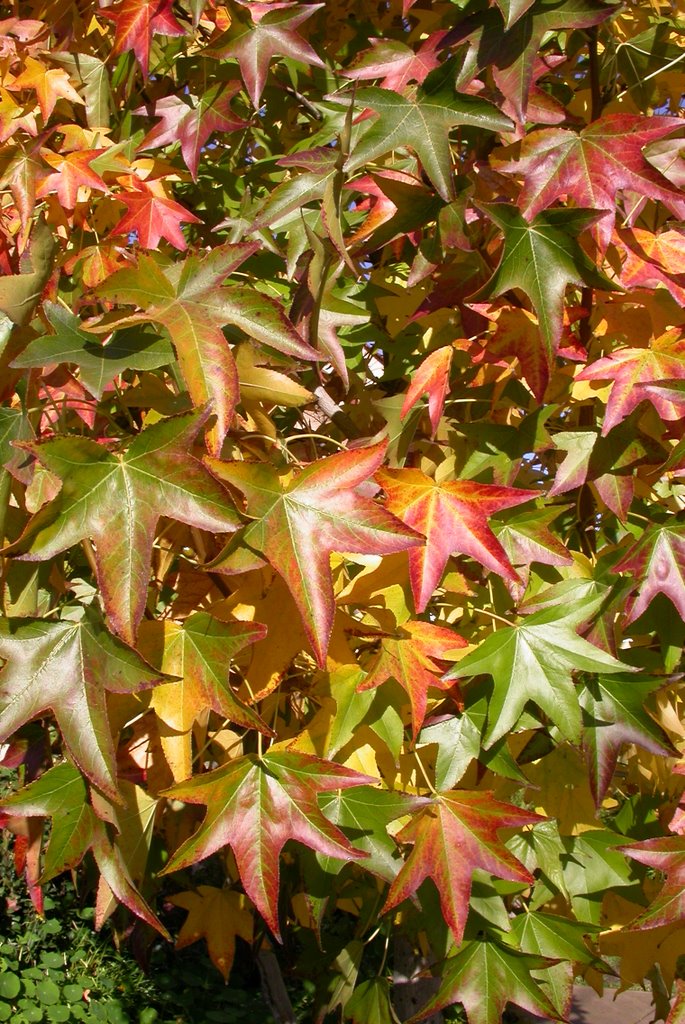
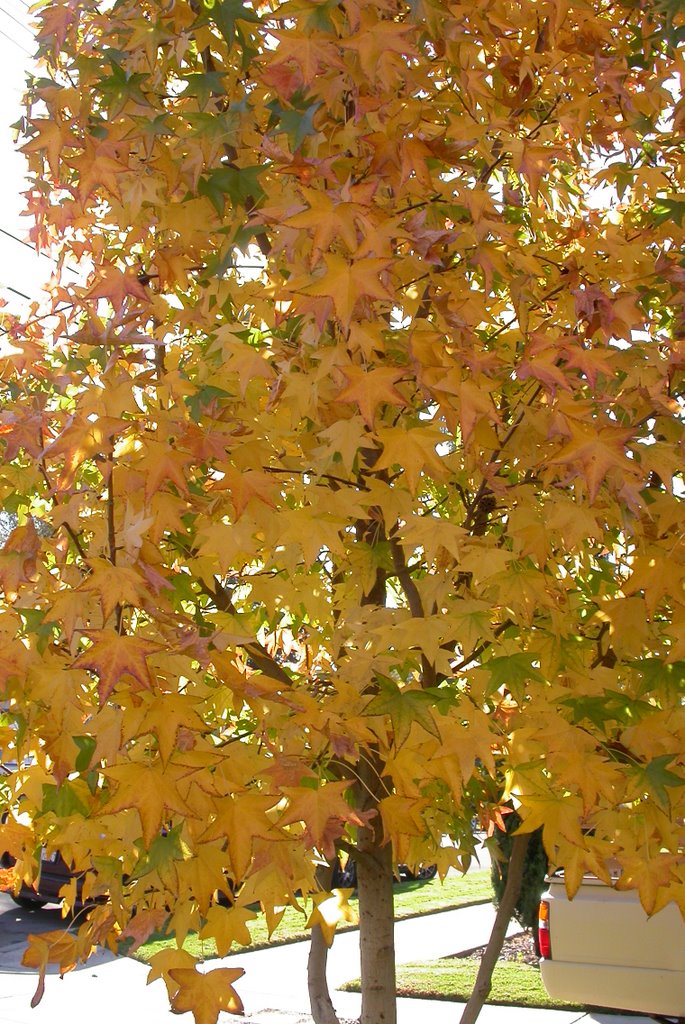
My liquidambar tree, or American Sweetgum, is finally in full glorious fall foliage, later than usual this year, but just in time for the holidays. Last year the tree turned red before dropping it's leaves. Two years ago, and again this year, the tree is mostly golden tinged with red, except for the south facing leaves which are mostly red with green.

Liquidambars are ubiquitous here in OC. It's a wonderful shade tree through the warm summer months and is one of the few reliable trees that provide fall foliage.

The seed pod, or fruit, is a spiney little ball. Hundreds of them will drop off the tree before it leafs out again in the spring. Beware the barefoot gardener!

Since the tree is deciduous, it's best to prune in the winter (in southern California, at least) when the tree is dormant. You can get a clear picture of the bones of the tree then. Cutting off the lower branches will help the tree grow taller if that is your aim. I've left the lower branches on because we are prone to Santa Ana winds. The lower branches keep the tree achored better than having the tree top heavy. I've planted mine in front of my house for privacy and the pure pleasure of seeing the autumn showstopping color framed by the picture window. It brings the outdoors in. During the winter months while the tree is dormant, it allows the sun to flow in through that window and warm the house on cool mornings. (Hopefully, we will have a few of those this January, just for a little variety.)

Planted about five years ago, my tree stands taller than the house and stalwart through the recent heavy winds.

Now don't you wish you awakened each morning to the sight of this lovely tree?

Labels:

Sunday, November 26, 2006

Weird and Wonderful Kalanchoe

As I mentioned in my last post, I'm becoming more and more enamored with cactus, succulents and euphorbia. They are fascinating in their variety of form and habit, generally easy to tend and for the most part drought tolerant.

Kalanchoe (cal an KO ee) is a member of the Crassulaceae family of succulents.

The most commonly found variety kalanchoe blossfeldiana, pictured with the white flowers at the left, can be found at any nursery or Home Depot. The flowers bloom several times a year here in southern California where they like the shade or a bit of filtered sun. The flowers bloom in a range of colors from white to hot pink, orange and yellow. I've seen some lately with double flowers, cute little puffs of color. These are easy to propagate from cuttings, are low growing and very rewarding in pots.

Other varieties growing in my garden, both in ground and in pots are a type that reproduces by growing new plantlets at the tips of their fleshy leaves. When these plantlets fall off of the fleshy leaves into the soil, they take root and produce new plants.

Chandelier Plant, Bryophyllum tubiflorum, whose orange flower stalk appears below, has a spotted tube shaped "leaf" with the plantlets growing at the tips. Mine has flowered and will die off soon. But it has dropped several new plants into the ground, and I hope for a new crop next year.

Mother of Thousands, above and below, kalanchoe daigremontiana or Bryophyllum daigremontianum
also propagates itself by dropping tiny plantlets off it's leaf margins. I have a variegated purplish one, seen below and a solid green one. The variegated variety has many more leaves and has started a varitable kalanchoe farm in the soil below.


These plants originated in Madagascar which seems to have the most wild, odd and wonderful plants grown anywhere on the planet.

In my next post I'll show a few more varieties of kalanchoe.

Labels: ,

Thursday, November 09, 2006

View from My Window

Now that the election is over I can hopefully extricate myself from the grip of the tractor beam that pulls me to the computer each morning. Bad enough that I refuse to leave the house until the LA Times SuDoku is done.

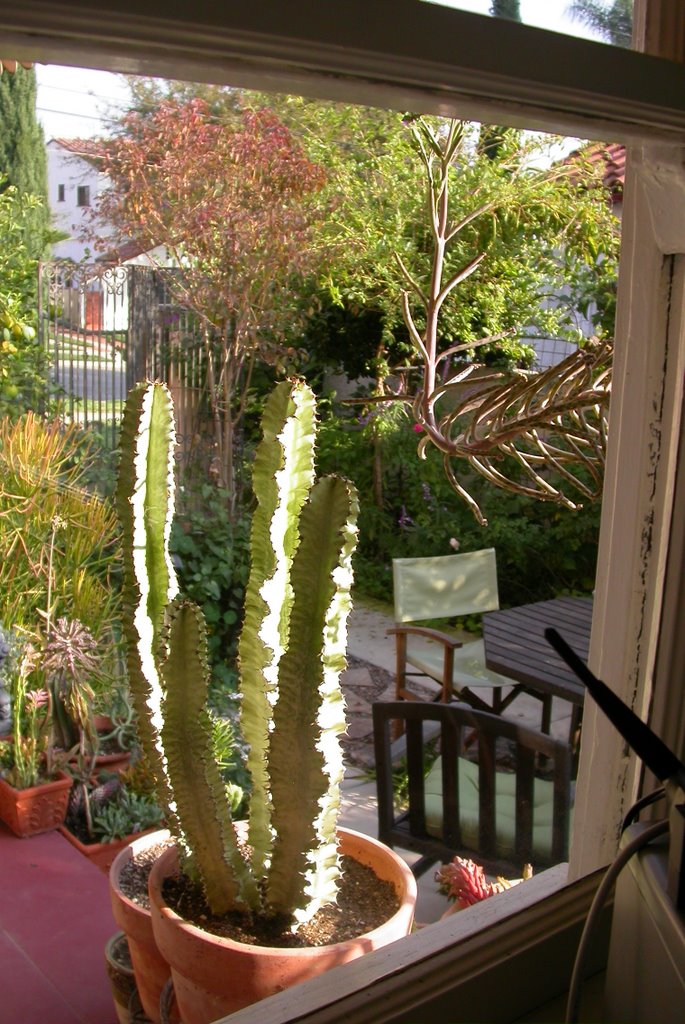
As you can see by the photo my new focus in the garden is succulents, cactus and euphorbia. Drought tolerant for the most part, and endless variety. Sculptural in every way, complete with flowery tassels.

I'll be blogging about these in the days to come.

And yes, that appendage in the lower right corner is my router, not a stapelea.

Labels: ,

Monday, October 16, 2006

Roses in October

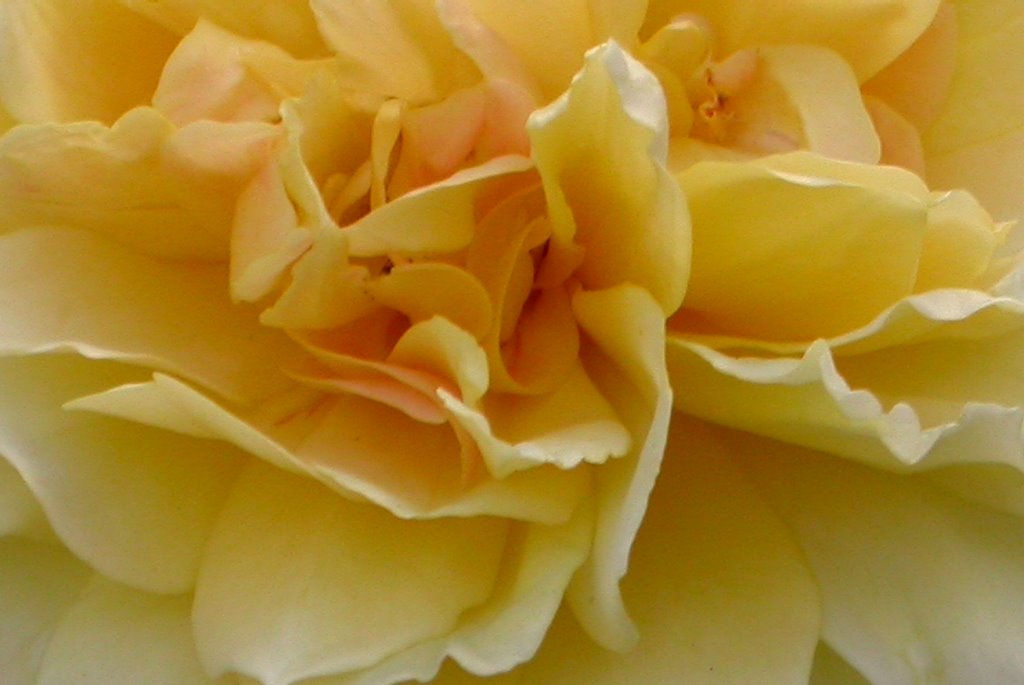
I can remember many past October days of near 100 degree heat with hot dry wind, sitting (standing, yelling) for my son's soccer team. Not this year. At least so far. Maybe last January's heat wave balances out our very cool, overcast autumn. The roses are once again happy. This David Austin rose Molineux Yellow is planted in a fairly smallish pot (for a rose) in the front of Casa Grande. And boy, does it hate the heat. During this summer's massive three week record breaking heat wave I pruned it back to nothing to give it and the other potted roses a rest. It's once again five feet tall and popping out these eye popping blooms. Bring on the rain! (I reserve the right to take back that last statement if we have another January like '05.)

Labels: ,

Tuesday, October 10, 2006

Hostess with the Mostest

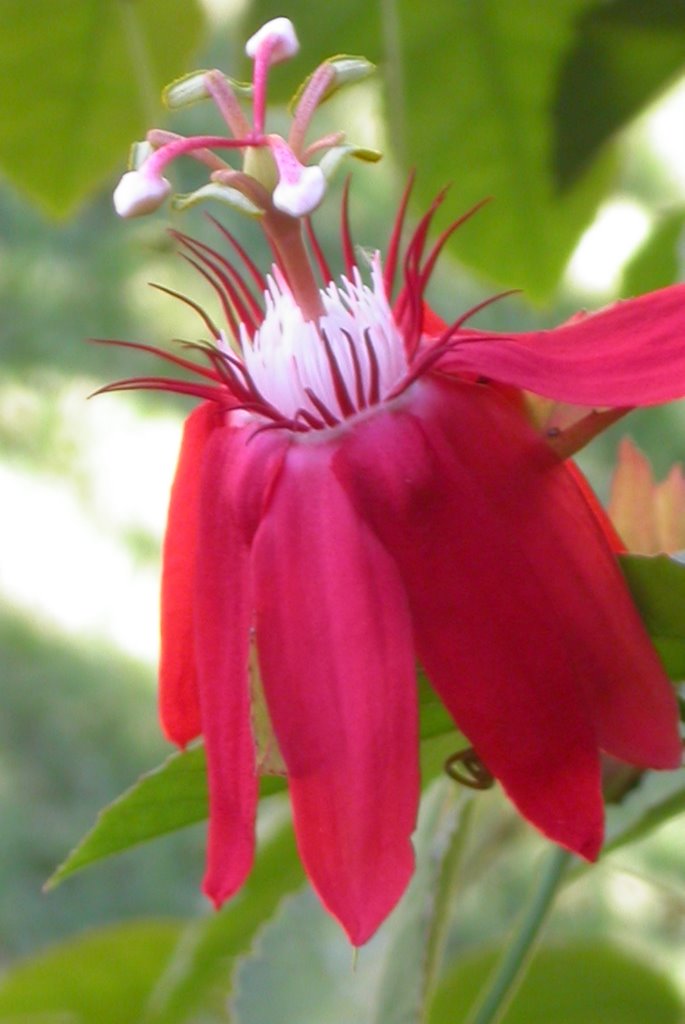
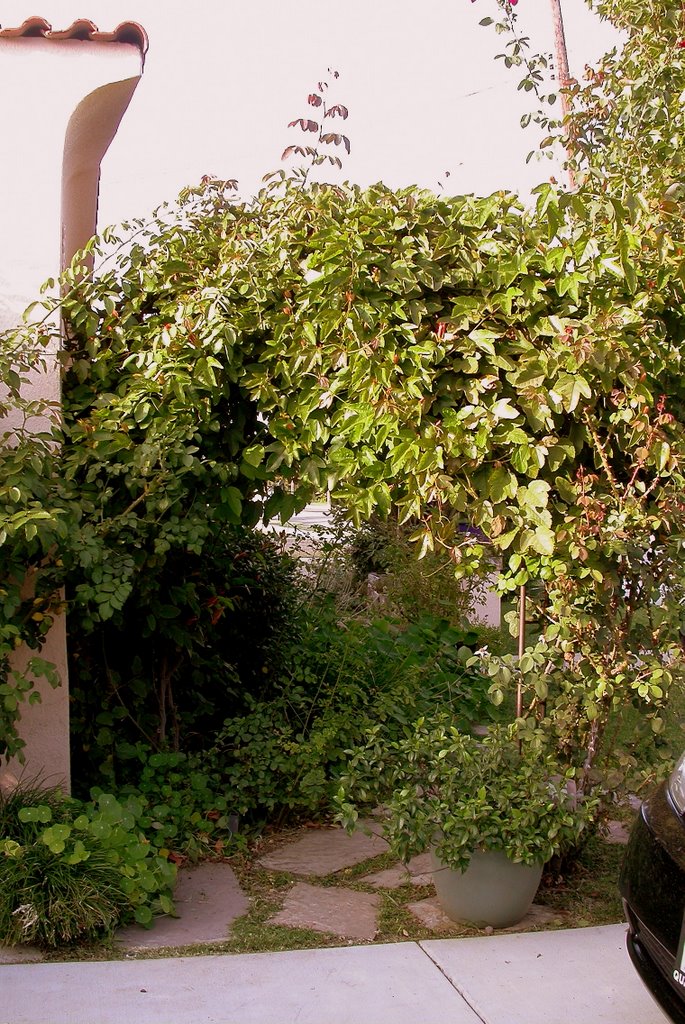
Red passion flower vine, passiflora coccinea, covers a six foot wide arbor at the front of Casa Grande near the driveway. This time of year it becomes a management problem. But cutting it back is fraught with guilt. It's the host plant for a butterfly I see frequently in my garden, the Gulf Fritillary, pictured here.
After close inspection, turns out butterflies are not the only thing being hosted.

This nest of paper wasps is under the arbor nestled in with some dead leaves. The thicket of leaves above is excellent protection from wind, rain and predators. The arbor is so densely entwined, it is sure to blow over with the first big Santa Ana blow.
Last year when the arbor blew over, I cut back the passion flower to it's main stem, about three feet tall. I feared it would not grow back. Boy, was I wrong.

Labels: